Health Checks
Two ways to get a clear-eyed read on your Employee Central tenant.
Sometimes you want a structured review of the whole environment. Sometimes one specific thing isn’t behaving and you need a focused expert on it. We offer both.
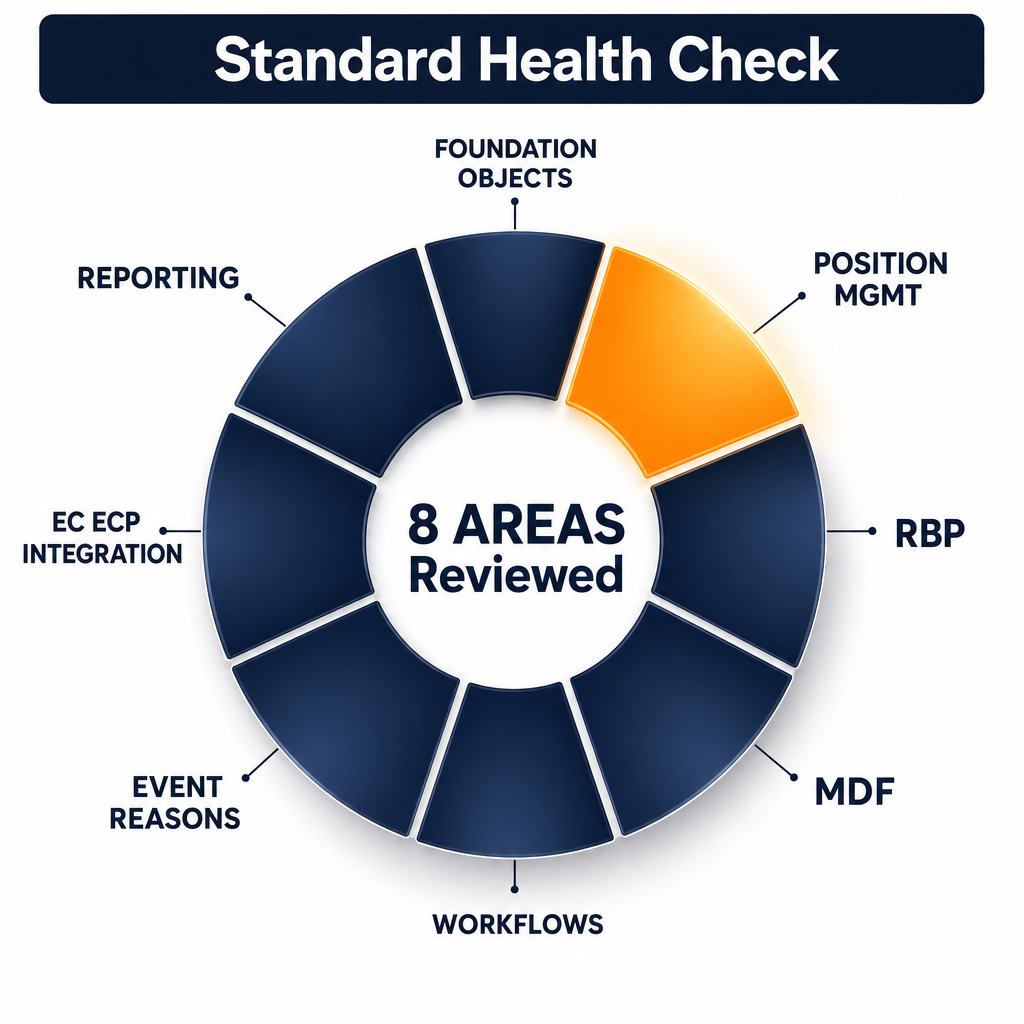
Standard Health Check
For HR leaders who want to know if their EC tenant is built to last.
Scope. Our 8-point review, run against your live configuration: Foundation Objects, Position Management, RBP, MDF, workflows, event reasons, EC↔ECP integration, reporting/analytics.
Effort. 2 weeks elapsed. Roughly 30–40 hours of consultant time. Read-only access plus 2–3 SME interviews.
Deliverable. A written findings report with each finding tagged severity (Critical / Recommended / Optional), specific configuration references, and the leading-practice rationale. 1-hour review call to walk the report.
Fee. Contact for pricing.
Targeted Issue Review
For when something specific is broken, behaving wrong, or about to be touched.
Scope. One problem, scoped at intake. Examples: a workflow firing inconsistently, an RBP pattern letting through what it shouldn’t, a picklist migration plan, a position-sync rule producing wrong results, a release-note impact assessment.
Effort. Sized to the issue. Typically 1–5 days.
Deliverable. Diagnosis, root cause, recommended fix, and either a hand-off doc or a configured fix applied through your partner.
Fee. Contact for pricing.
How we run them
Every health check is led by a principal consultant and run against the same 8-point framework, so the output is consistent regardless of who is in your tenant. Findings are evidence-based: every item cites the specific configuration it came from, so your team can verify it independently rather than take our word for it.
Who this is for
Standard Health Checks are most useful before a major change (acquisition, ERP migration, new module rollout) or after a rocky go-live. Targeted Issue Reviews are most useful when your team has narrowed the problem and needs senior expertise to close it out.